Daniel Peña R.
An AI engineer builds AI systems, in your product or in your internal tools: LLM features, retrieval systems, agents, and the evaluations that help keep them reliable. An AI-augmented engineer is a software engineer who uses AI tools to speed up parts of their work. Which one you need depends on whether you’re building AI or want your team to work faster with it.
If you run a SaaS company, someone has probably asked about your AI hiring plan this quarter. Maybe it was your board. Maybe it was your own roadmap, with a feature that now needs a model behind it. The pressure shows up in hiring data too: LinkedIn ranked AI engineer as the fastest-growing job in the U.S. in its 2026 Jobs on the Rise report.
The trouble starts with the job title. “AI engineer” is now used for two very different profiles: one builds AI systems, while the other builds the product with help from AI, and each brings different skills to solve different problems.
This article focuses on generative AI, the kind built on large language models (LLMs). And the two profiles aren’t mutually exclusive: an AI engineer can also work in an AI-augmented way. The real question is which focus your team needs most.
Hire for the wrong focus, and you end up paying for expertise you won’t use, or waiting months for a capability your team still doesn’t have. Here’s how to tell the two apart, and how to decide which one to bring on first.
Two Roles, Side by Side
The AI engineer
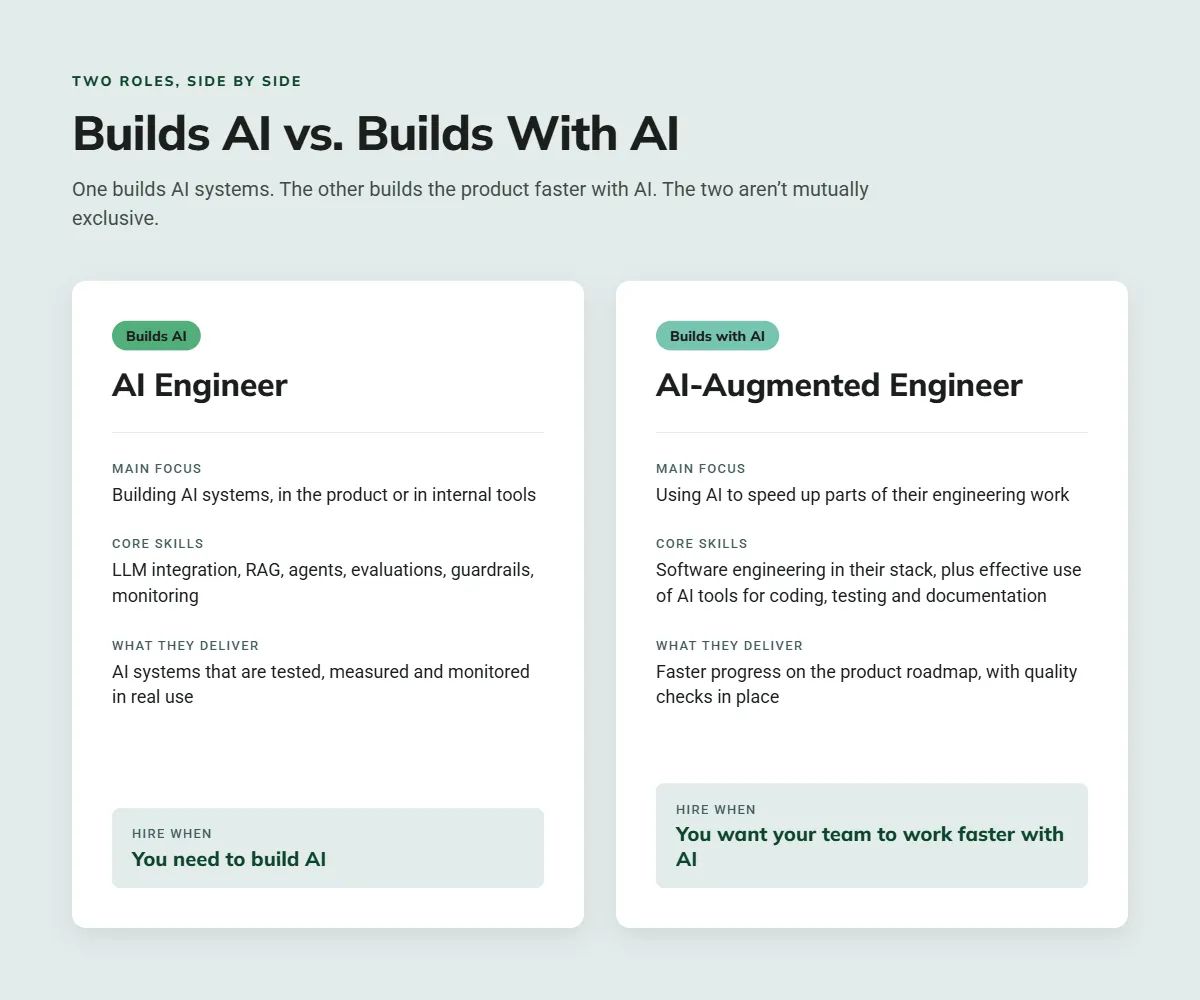
An AI engineer’s job is to build systems that use AI, whether they’re features your customers see or internal tools your teams rely on. They connect LLMs to your applications, design how those models access the information they need, and test how the results hold up in real use. For a K–6 literacy platform, for example, our engineers built an AI proof of concept in four weeks that combined two speech-recognition engines with real-time LLM feedback, and it was deployed to school Chromebooks.
A big part of an AI engineer’s work is retrieval-augmented generation (RAG), a technique that lets an AI model pull information from sources outside the model, such as your product documentation, before it answers. Think of a support assistant that checks your help center and past tickets before it replies. RAG doesn’t retrain the model, and it doesn’t guarantee correct answers, which is why the rest of the job matters so much. AI engineers also build agents that complete multi-step tasks, and they set up the evaluations, guardrails, and monitoring that help detect and reduce errors over time.
Related titles include AI/ML engineer, AI platform engineer, and agent engineer, although their scope varies from company to company. In every case, success means AI systems that perform well in real use and keep being measured after launch. That distinction matters. In McKinsey’s 2026 global survey on AI, only 37% of respondents reported a positive EBIT impact from AI, and just 6% qualified as AI high performers, attributing at least 5% of their EBIT to it.
The AI-augmented engineer
An AI-augmented engineer is a backend, frontend, QA, or DevOps engineer who has made AI part of their daily workflow. More than a job title, it describes a way of working. They use AI tools to draft code, review pull requests, write tests, debug, and document, which can speed up many of those tasks.
Their most important skill is judgment: knowing when an AI suggestion is right, when it only looks right, and how to tell the difference before it reaches production. An engineer who accepts every suggestion can move fast in the wrong direction. One who verifies carefully gets more of the speed while reducing the risk.
Success here looks like faster progress on the roadmap, with the same review and quality standards your team already holds.
The key differences
Which One Does Your Team Need?
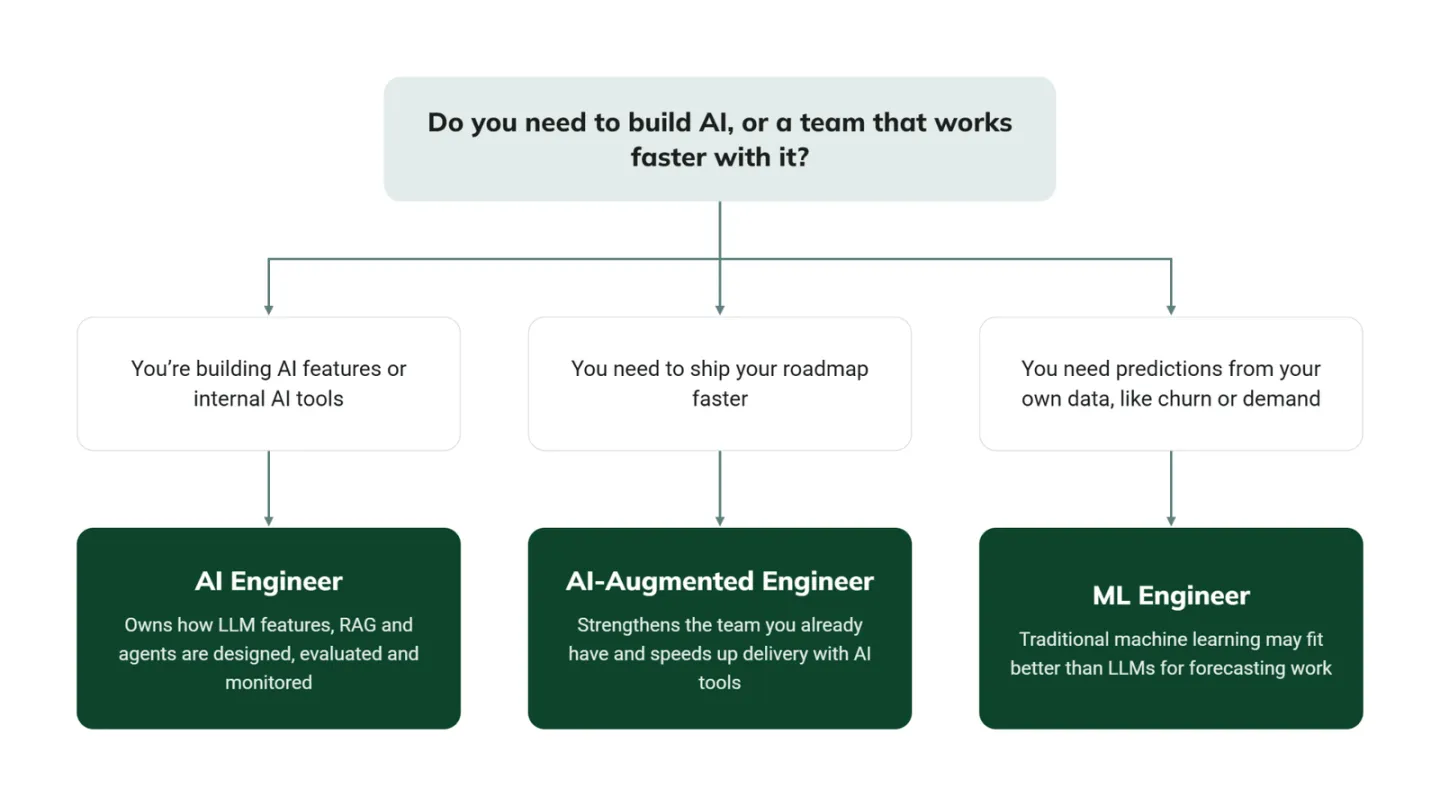
Start with one question: do you need someone to build AI, or a team that works faster with it?
If you aren’t building AI features or tools yet, and the pressure is to ship your roadmap faster, AI-augmented engineers are often the better first hire. They strengthen the team you already have without adding a new specialty to manage.
If you’re building, or about to build, AI systems, you need AI engineering expertise. That could be a copilot inside your app, an agent that completes tasks for your users, or an internal assistant for your support team. Someone has to own how those systems are designed, evaluated, and monitored, and that is a specialty in its own right. One example from our own work: our engineers built an AI-assisted support routing engine for a growth-stage B2B SaaS company, integrated with Zendesk and delivered in nine weeks.
If what you need is predictions built on your own data, such as churn or demand forecasts, keep in mind that the work may call for traditional machine learning rather than LLMs, and an ML engineer may be the better fit.
Many growing SaaS companies end up needing both: AI engineers who own the AI systems, and a team of AI-augmented engineers moving fast around them.
If you’re still unsure, these three questions usually help settle it:
- Do we need to build AI systems, or to work faster with AI?
- Do we have AI features or tools in production that need evaluation and guardrails?
- Where is our team losing time that AI tools could help recover?
Four Common Hiring Mistakes
- Evaluating tools instead of results. Knowing the names of the latest models and assistants says little about what a candidate can deliver. Ask what they built and what changed because of it.
- Taking “AI” on a résumé at face value. Many résumés now list AI experience. The question that matters is what reached production, and how the candidate knew it was working.
- Treating AI-augmented engineers as junior AI engineers. They aren’t a lesser version of the same role. They’re strong software engineers with a different focus, and for many teams they’re the right first hire.
- Hiring for today’s stack. AI tools engineers rely on change constantly, and the World Economic Forum expects about 39% of workers’ core skills to change by 2030. A candidate who masters this year’s toolkit but stops learning will fall behind quickly.
How to Evaluate AI Skills in an Interview
At DevSavant, we ask every candidate for a recent, concrete example of how they use AI: the problem it solved, how they verified the output, and what result it produced. For technical roles, we go deeper into their workflows, the guardrails they put in place, how they evaluate results, and how they exercise independent judgment. What we look for is responsible, applied use of AI, not familiarity with tools.
You can use the same approach in your own interviews. Watch for these red flags:
- Answers built around tool names rather than problems solved.
- No clear process for checking the AI’s output.
- No clear, verifiable outcome: nothing shipped, nothing improved, nothing fixed.
Questions to ask an AI engineer
- Tell me about an AI feature or tool you took to production. How did you know it was working?
- How did you evaluate the quality of the model’s output, and what did you change based on the results?
- What guardrails did you put in place, and what did they catch?
- When would you decide not to use an LLM to solve a problem?
Questions to ask an AI-augmented engineer
- Walk me through a recent task where AI made you faster. What did you do yourself, and what did you hand off?
- Tell me about a time an AI suggestion looked right but wasn’t. How did you catch it?
- How do you review AI-generated code before it goes into a pull request?
- Is there a part of your work where you’ve decided AI doesn’t help?
Why Mindset Matters as Much as the Stack
AI tools and workflows evolve quickly, and the skills that matter today may look different next year. The engineers who keep learning are the ones who stay valuable. That’s why our WOW Profiles framework looks beyond the stack for drive and a growth mindset: the internal motivation to raise the bar without external pressure, and the belief that abilities develop through effort and learning.
Hiring Either Profile in Latin America
Whichever profile you need, AI work rewards close collaboration. Features change as you test them, outputs need review, and decisions happen in short loops. Working hours that overlap with your team keep those loops short.
That’s one reason SaaS companies hire AI talent in Latin America. At DevSavant, we place AI and ML engineers, data specialists, and software engineers across the stack, all selected for how they learn, take ownership, and use AI. We typically present the first candidates within 7–10 business days, depending on the role’s complexity and seniority.
Frequently Asked Questions
Is an AI-augmented engineer a junior AI engineer?
No. An AI-augmented engineer is a software engineer, often a senior one, who uses AI tools in their daily work. An AI engineer specializes in building AI systems. The two profiles differ in focus, not in seniority, and one person can be both.
Can a software engineer become an AI engineer?
Yes, and it’s a common path. The transition usually involves learning to work with LLMs, build retrieval systems, evaluate model output, and design guardrails. Strong software fundamentals make that path much easier.
What’s the difference between an AI engineer and an ML engineer?
An ML engineer often works on building, deploying, and maintaining machine learning models, including traditional models that don’t involve LLMs, such as those used for forecasting or classification. An AI engineer more often builds systems on top of existing models, such as LLMs, with a focus on integration, retrieval, evaluation, and monitoring. The line between the two titles varies by company, so it helps to define the work, not just the title.